Category: Solar Panels

  • Solar Panel Maintenance: How to Clean & Care for Your System

    Solar Panel Maintenance: How to Clean & Care for Your System


    Solar panels are often marketed as “set and forget” — and compared to most home appliances, they genuinely are low maintenance. But low maintenance does not mean no maintenance. In Australia’s uniquely demanding climate, neglecting basic solar panel maintenance can silently cost you thousands of dollars in lost energy generation over the life of your system — without a single fault code on your inverter to warn you something is wrong.

    Whether you installed your system last month or five years ago, this expert solar panel maintenance guide covers everything Australian homeowners and businesses need to know to keep their system performing at its best — from DIY cleaning techniques to professional servicing schedules, seasonal care considerations, and the warning signs that should never be ignored.


    Why Solar Panel Maintenance Matters More in Australia

    Australia is one of the most demanding environments in the world for solar panel maintenance. While the abundant sunshine is the very reason solar performs so well here, it also means Australian panels are exposed to conditions that accelerate soiling, degradation, and component wear more rapidly than in cooler, wetter climates.

    The most common environmental factors that make solar panel maintenance critical in Australia include:

    Dust and Airborne Particles — Inland and semi-rural properties are exposed to significant dust accumulation, particularly during dry seasons and dust storm events. A film of dust across your panels can reduce output by 5 to 25% depending on severity — a loss that is entirely preventable with regular cleaning.

    Bird Droppings — Bird activity on and around rooftops is a significant solar panel maintenance issue across Australia. Unlike dust, bird droppings create concentrated shading on individual cells, which can cause hotspot damage over time — a serious issue that reduces panel lifespan and may void manufacturer warranties if left unaddressed.

    Bushfire Ash and Debris — In bushfire-prone regions, ash and leaf debris can accumulate rapidly on panel surfaces and in panel gaps, creating both performance and fire safety concerns.

    Coastal Salt Air — Properties within several kilometres of the coastline are exposed to salt-laden air that, over time, deposits a crystalline film on panel surfaces and can accelerate corrosion of frames, junction boxes, and mounting hardware if not addressed during routine solar panel maintenance.

    Extreme UV and Heat — Australia’s intense UV environment accelerates the degradation of encapsulant layers and junction box seals faster than in less sun-exposed countries — making professional inspection an important part of long-term solar panel maintenance.


    How Often Should You Clean Solar Panels in Australia?

    The right cleaning frequency depends on your location, local environment, and roof pitch. As a general guide:

    Location TypeRecommended Cleaning Frequency
    Urban / SuburbanEvery 6 to 12 months
    Rural / Inland (dusty)Every 3 to 6 months
    Coastal (salt air)Every 3 to 6 months
    Bushfire-prone regionAfter every significant fire event + annually
    High bird activity areaEvery 3 to 4 months
    Low-pitch roof (under 10°)Every 3 months (rain doesn’t self-clean effectively)

    Panels installed at a pitch of 15 degrees or more in areas with regular rainfall will self-clean to some extent — but only from loose dust, not sticky bird droppings, salt deposits, or ash residue, which require manual attention as part of your solar panel maintenance routine.


    DIY Solar Panel Cleaning: Step-by-Step Guide

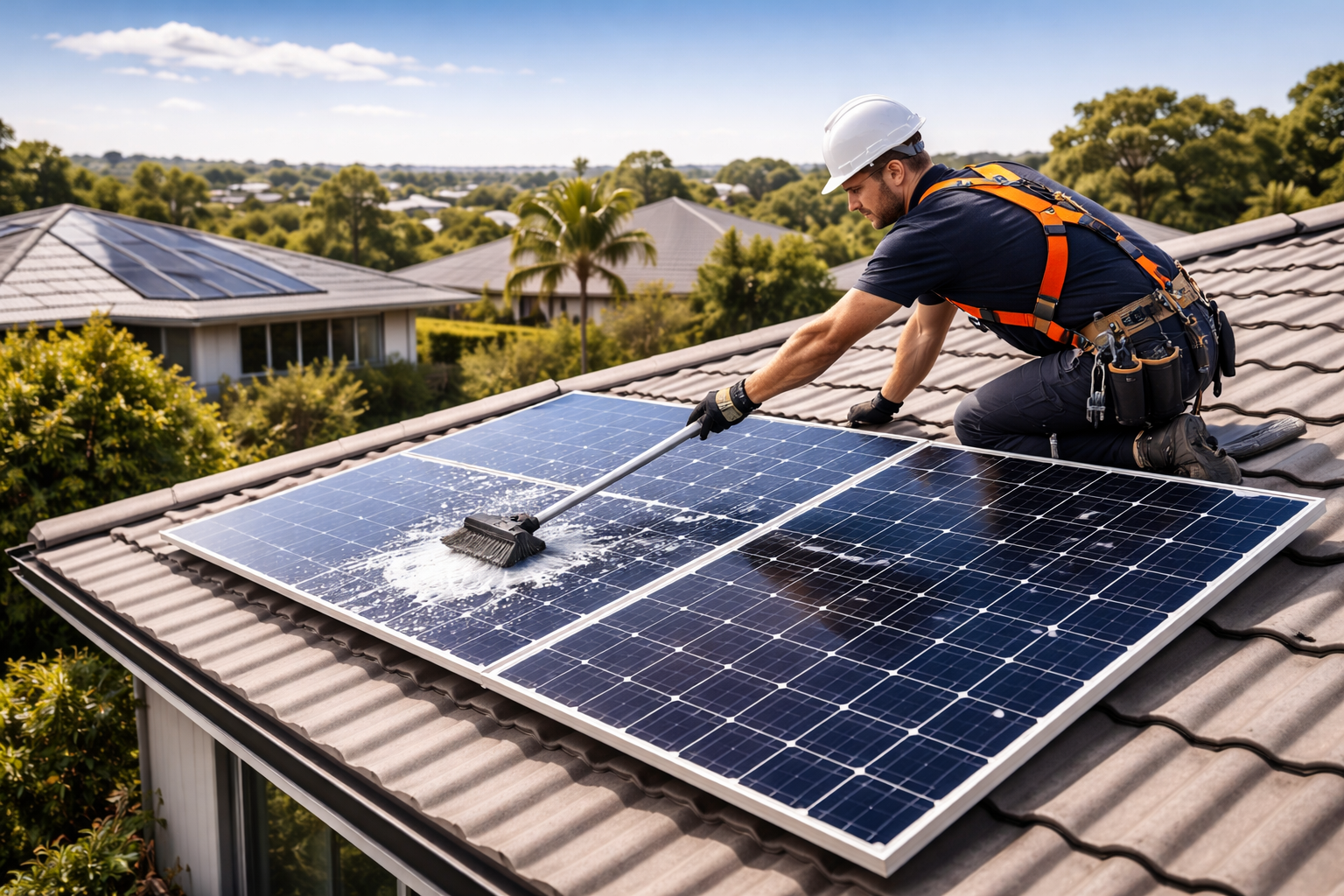
    For most Australian homeowners, basic solar panel maintenance cleaning can be performed safely and effectively as a DIY task with the right approach.

    What You Will Need:

    • Soft-bristle brush or squeegee with an extension pole
    • Garden hose with a gentle spray nozzle
    • Mild biodegradable dish soap (optional)
    • Soft non-abrasive cloth or chamois
    • Safety equipment if roof access is required

    Step 1: Choose the Right Time Clean your panels early in the morning or on a cool, overcast day. Never clean hot panels with cold water — the thermal shock can cause microcracks in the glass. Morning cleaning also ensures panels are fully dry and back to optimal output by peak sunlight hours.

    Step 2: Turn Off Your Solar System Before beginning any solar panel maintenance, switch off your solar inverter at the isolator switch as directed in your system’s manual. This is a critical safety step.

    Step 3: Rinse Panels With Water Use a garden hose to gently rinse the panel surface from top to bottom, removing loose dust and debris. Use a gentle spray — never a high-pressure washer, as this can damage the panel surface, seals, and frame.

    Step 4: Gently Scrub if Needed For stubborn bird droppings or salt residue, apply a small amount of mild soapy water with a soft brush or cloth and gently agitate the affected area. Avoid abrasive pads, scourers, or harsh chemical cleaners — these will scratch the anti-reflective coating on your panels and permanently reduce output.

    Step 5: Final Rinse and Dry Rinse all soap residue thoroughly with clean water. If possible, use a soft squeegee or chamois to remove water spots, which can leave mineral deposits on the glass surface over time.

    Step 6: Restore Power and Check Output Switch your inverter back on and check your monitoring app or inverter display to confirm the system has returned to normal operation.


    What NOT to Do When Cleaning Solar Panels

    Poor cleaning technique is one of the most common causes of avoidable damage during solar panel maintenance. Always avoid:

    What to AvoidWhy It Causes Damage
    High-pressure washingDamages seals, frames, and can cause delamination
    Abrasive cleaning padsScratches anti-reflective coating permanently
    Harsh chemical cleanersDegrades encapsulant and frame anodising
    Cleaning in full sun / heatThermal shock causes microcracks in glass
    Walking on panelsCauses immediate physical damage to cells
    Metal scrapers or toolsScratches glass and damages surface coatings
    Tap water with high mineral contentLeaves hard water deposits — use filtered water if possible

    Professional Solar Panel Servicing: What It Includes

    While regular DIY cleaning handles the surface component of solar panel maintenance, professional servicing goes much deeper — inspecting the elements of your system that you cannot assess from the ground or with a garden hose.

    A professional solar panel maintenance service typically includes:

    Visual Panel Inspection — Physical inspection of all panels for microcracks, delamination, discolouration, hotspots, and physical damage that reduces output or poses a safety risk.

    Inverter Health Check — Inspection of inverter error logs, connection integrity, ventilation, and firmware to ensure it is operating within normal parameters.

    Wiring and Junction Box Inspection — Checking DC and AC wiring, conduit, junction box seals, and connections for signs of degradation, rodent damage, moisture ingress, or loose terminations — all significant safety and performance risks.

    Mounting and Racking Inspection — Checking roof mounting hardware, racking rails, and panel clamps for corrosion, loosening, or structural movement, particularly important in coastal and high-wind regions.

    Thermal Imaging (Premium Service) — Infrared thermal imaging identifies hotspots, cell failures, and bypass diode faults invisible to the naked eye — one of the most valuable tools in advanced solar panel maintenance.

    Performance Analysis — Comparing actual system output against modelled expected generation to identify any underperformance and diagnose its cause.


    How Often Should You Book a Professional Service?

    System AgeRecommended Service Frequency
    0 – 2 yearsOnce — post-installation inspection at 12 months
    2 – 5 yearsEvery 2 years
    5 – 10 yearsAnnually
    10+ yearsAnnually — include thermal imaging every 2 years

    Older systems benefit from more frequent professional solar panel maintenance as component degradation, seal deterioration, and wiring fatigue become increasingly relevant from year 10 onwards.


    Warning Signs Your System Needs Immediate Attention

    Do not wait for your next scheduled service if you notice any of the following — these are indicators of a problem that should be investigated promptly as part of urgent solar panel maintenance:

    Sudden Drop in Energy Output — If your monitoring app shows a significant unexplained drop in daily generation that persists across multiple days, this warrants immediate investigation. A 10–15% or greater sustained drop in output that cannot be explained by weather or seasonal variation is a red flag.

    Inverter Fault or Error Codes — Modern inverters display fault codes when something is wrong. Do not ignore these — check your inverter manual for the specific code meaning and contact your installer if the fault persists after resetting.

    Discolouration or Yellowing on Panels — Yellow or brown discolouration on panel surfaces or within the panel itself indicates encapsulant degradation or moisture ingress — both of which accelerate further deterioration and may be covered by your product warranty.

    Visible Physical Damage — Cracks, chips, delamination bubbles, or broken frames should be reported to your installer immediately. Damaged panels are both a performance and safety concern.

    Burning Smell Near Inverter or Switchboard — This is an urgent electrical safety issue that requires immediate power isolation and a call to your installer or a licensed electrician.

    Rodent Activity Near Roof Penetrations — Rodents gnawing through DC cabling is an increasingly common issue in Australian homes and can cause arcing, fire risk, and complete system failure.


    Solar Panel Maintenance and Your Warranty

    Understanding how solar panel maintenance obligations intersect with your warranty is essential for Australian system owners.

    Most panel manufacturers require that the system is maintained in a reasonable condition to honour performance warranty claims. Neglect that causes damage — such as bird dropping hotspots that were clearly visible and unaddressed for extended periods — can give a manufacturer grounds to dispute a warranty claim.

    Key warranty maintenance points to be aware of:

    Warranty TypeTypical Maintenance Requirement
    Product WarrantyProper installation, no physical damage from neglect
    Performance WarrantySystem must be operational and maintained
    Inverter WarrantyRegular firmware updates, adequate ventilation
    Workmanship WarrantyReport faults promptly to the installing company

    Keeping a simple maintenance log — recording cleaning dates, any observed issues, and professional service visits — provides documented evidence of proper care if a warranty claim ever becomes necessary.


    Seasonal Solar Panel Maintenance Checklist

    Australian conditions vary significantly by season. Here is a practical seasonal solar panel maintenance checklist to keep your system in peak condition year-round.

    SeasonMaintenance Actions
    SummerCheck for heat-related inverter shutdowns. Clean panels after dust storms. Ensure inverter ventilation is unobstructed. Monitor output daily.
    AutumnClear leaf debris from panel edges and gutters. Check mounting hardware before winter. Clean panels after any bushfire smoke events.
    WinterCheck inverter is performing correctly in cold mornings. Clean panels after heavy dew or fog events. Review annual output data.
    SpringFull clean after winter. Professional service inspection recommended. Check for bird nesting activity under or near panels. Review monitoring data for any persistent underperformance.

    Does Solar Panel Maintenance Affect Performance?

    The short answer is yes — significantly. Studies consistently show that dirty panels in Australian conditions can lose between 5% and 25% of their rated output depending on soiling type and severity. Over a full year, that performance loss has a direct impact on your electricity bill savings and your system’s return on investment.

    For a 6.6kW system generating approximately $1,800 per year in electricity savings, a sustained 15% output reduction from poor solar panel maintenance equates to $270 in lost savings annually — money that a single cleaning visit would more than recover. Over a 10-year period, that same neglect compounds to over $2,700 in avoidable losses.

    Proper solar panel maintenance is not a cost — it is an investment protection strategy that ensures your system delivers the returns it was designed to provide for its full 25-year lifespan.

    If you need professional solar panel maintenance, servicing, or a system health check anywhere in Australia, the expert team at Boost Solar is here to help — from routine cleaning and inspections through to full system diagnostics and repairs.


    Frequently Asked Questions

    1. How often should solar panels be cleaned in Australia? For most Australian properties, solar panel maintenance cleaning should be carried out every 6 to 12 months. Properties in dusty inland areas, coastal locations, bushfire-prone regions, or areas with high bird activity should clean more frequently — every 3 to 6 months. Panels on low-pitch roofs also require more regular attention as they do not self-clean as effectively in rainfall. Monitoring your system’s output via your inverter app is the most reliable way to detect when soiling is affecting performance and cleaning is overdue.

    2. Can I clean my solar panels myself or do I need a professional? Basic surface cleaning is a task most Australian homeowners can perform safely as part of their solar panel maintenance routine — provided they can access their panels safely from the ground using an extension pole, or have safe roof access. Use a soft brush, gentle hose rinse, and mild soapy water if needed. However, if your panels are difficult to access, your roof is steep, or you need anything beyond surface cleaning — such as wiring checks, inverter inspection, or thermal imaging — always engage a qualified solar technician. Safety must always come first.

    3. Will rain clean my solar panels naturally? Light rainfall helps remove loose surface dust from panels installed at a reasonable pitch, but it is not sufficient solar panel maintenance on its own. Rain does not remove bird droppings, salt deposits, sticky pollen, or bushfire ash — all of which require manual cleaning. After a rain event, mineral deposits from the water itself can also leave a thin residue on panel surfaces. Regular manual cleaning remains essential even for properties that experience frequent rainfall.

    4. Does poor maintenance void my solar panel warranty? Most solar panel manufacturers expect that systems are maintained in a reasonable condition. Neglect that causes or accelerates damage — such as leaving corrosive bird droppings on panels for extended periods, allowing debris to trap moisture against frames, or failing to address visible physical damage — can give manufacturers grounds to dispute warranty claims. Keeping a basic solar panel maintenance log of cleaning dates and any observed issues is a simple and effective way to protect your warranty entitlement for the full duration of your product and performance warranty periods.

    5. How much does professional solar panel maintenance cost in Australia? Professional solar panel maintenance service costs in Australia typically range from $150 to $400 for a standard residential inspection and clean, depending on system size, roof accessibility, and the scope of the service. More comprehensive services including thermal imaging, inverter diagnostics, and detailed performance reporting sit at the higher end of this range. While this cost may seem significant for an annual service, it is modest relative to the electricity savings your system generates and the long-term protection it provides for a $5,000 to $14,000+ asset sitting on your roof.


    Final Word

    Solar panel maintenance is the most overlooked component of solar ownership in Australia — and the one that most directly determines whether your system delivers on its financial promise for 25 years or quietly underperforms while you assume everything is fine.

    The good news is that keeping your system in peak condition does not require a significant time or financial commitment. A simple cleaning routine, a professional service every one to two years, and the habit of monitoring your system’s output are all it takes to protect one of the best financial investments your home or business will ever make.

    Do not wait until something visibly breaks to pay attention to your solar system. The energy — and money — you save through proper solar panel maintenance compounds every single year.
  • LONGi Solar Panels: Complete Models, Efficiency & Comparison

    LONGi Solar Panels: Complete Models, Efficiency & Comparison


    LONGi solar panels have become one of the most discussed names in the Australian solar market — and for good reason. As the world’s largest solar manufacturer by market capitalisation, LONGi has spent over two decades pushing the boundaries of monocrystalline silicon technology, consistently achieving efficiency milestones that once seemed beyond the reach of mass-produced panels. In 2026, LONGi solar panels sit firmly in the premium-to-mid-tier category, offering a compelling combination of high efficiency, strong warranties, and competitive pricing that appeals to both residential and commercial buyers across Australia.

    But is a LONGi solar panel the right choice for your home or business? This complete review covers every major model in LONGi’s current lineup, their real-world efficiency and performance credentials, how they compare to competing brands, and what Australian buyers need to know before making a decision.


    Who Is LONGi Solar?

    The story behind LONGi solar panels begins with the company’s founding in 2000 in Xi’an, China, and has since grown into the world’s largest solar company by both production volume and market value. The company produces over 110GW of solar products annually — including wafers, cells, and finished panels — and has been the single most influential force behind the industry’s global shift from polycrystalline to monocrystalline silicon technology.

    LONGi Solar specialises exclusively in monocrystalline products and played a key role in the industry’s shift toward higher-quality monocrystalline cells. Their manufacturing facilities span China, Malaysia, Vietnam, and India, and their LONGi solar panels are sold in over 150 countries, giving them the scale and supply chain resilience to maintain consistent product quality and competitive pricing.

    LONGi solar panels carry the backing of a company with a Bloomberg New Energy Finance Tier 1 rating — the industry’s gold standard for bankability and financial stability — giving Australian buyers confidence that their warranty claims will be honoured well into the future.


    LONGi Solar Panel Technology: What Makes Them Different?

    Understanding what makes LONGi solar panels stand out requires a closer look at the technologies that power them. LONGi’s competitive advantage has always been rooted in silicon cell innovation, and their current lineup spans three distinct cell technologies.

    TechnologyUsed InCell EfficiencyBest For
    HPBC (Hybrid Passivated Back Contact)Hi-MO 6, Hi-MO X625.0%+Residential, premium rooftop
    HPBC Pro / HPBC+Hi-MO 6 Scientist, Hi-MO X6 Explorer25.3% – 25.8%Premium residential & commercial
    TOPCon N-typeHi-MO 7Up to 23% module efficiencyLarge commercial & utility
    PERC Mono Half-cutHi-MO 5Up to 21.4%Cost-effective commercial

    LONGi’s HPBC cell technology opens a new chapter in the mass production of high-efficiency cells, with HPBC cell efficiency exceeding 25.0% and the PRO version exceeding 25.3%.

    The key advantage of LONGi’s HPBC technology is that it delivers N-type-level efficiency using a refined P-type cell structure — meaning homeowners get premium performance without the premium price tag traditionally associated with N-type panels like HJT or IBC.


    LONGi Solar Panel Models: Full 2026 Lineup

    1. LONGi Hi-MO X6 — Flagship Residential Series

    Cell Technology: HPBC+ | Module Efficiency: Up to 22.8% | Power Output: 430W – 580W Product Warranty: 15 years | Performance Warranty: 30 years

    The Hi-MO X6 is LONGi’s flagship residential product and the most advanced LONGi solar panels model available for Australian homeowners in 2026. The Hi-MO X6 features HPBC+ cells with efficiency exceeding 25.8%, simplicity redefined in a new aesthetic module design, and an extra long warranty that maximises product reliability.

    The Hi-MO X6 family includes several sub-variants tailored to different installation needs:

    • Hi-MO X6 Explorer — Standard residential model with HPBC technology
    • Hi-MO X6 Explorer (Bifacial) — Dual-glass bifacial variant for maximum output in high-reflectivity environments
    • Hi-MO X6 Anti-Dust — Features an innovative anti-dust frame design that reduces soiling losses and cleaning frequency — ideal for Australian properties in dusty inland or coastal environments

    Best for: Premium residential installations, properties with limited roof space, homeowners seeking maximum long-term energy yield.


    2. LONGi Hi-MO 6 — Advanced Residential & Light Commercial

    Cell Technology: HPBC / HPBC Pro | Module Efficiency: Up to 22.8% | Power Output: 500W – 580W Product Warranty: 15 years | Performance Warranty: 30 years

    The Hi-MO 6 series brought LONGi solar panels to a new performance tier when it launched and remains a benchmark product in 2026. The Hi-MO 6 Scientist series features HPBC Pro cells with efficiency exceeding 25.3%, pioneers full back welding technology to improve resistance to micro-cracking, and delivers an extra long warranty to maximise product reliability.

    The Hi-MO 6 lineup includes:

    • Hi-MO 6 Explorer — Core high-efficiency HPBC residential model
    • Hi-MO 6 Scientist — Premium variant using HPBC Pro cells for higher output
    • Hi-MO 6 Intelligent — Integrates an intelligent optimiser for real-time monitoring, rapid shutdown capability, and per-panel performance optimisation — ideal for rooftops with partial shading

    Best for: Medium to large residential homes, light commercial rooftops, shading-affected installations (with Intelligent variant).


    3. LONGi Hi-MO 7 — Commercial & Utility Grade

    Cell Technology: TOPCon N-type | Module Efficiency: Up to 23% | Power Output: Up to 620W Product Warranty: 15 years | Performance Warranty: 30 years

    The Hi-MO 7 is the highest-wattage LONGi panel at 620W and the most efficient model in the lineup at 23% efficiency, using TOPCon N-type cell technology.

    The Hi-MO 7 is designed for large-scale commercial rooftops, industrial facilities, and utility-scale ground-mount installations where maximising total energy output per system is the priority. Its large-format design and N-type TOPCon cell technology deliver lower degradation rates and superior performance over the full 30-year warranty period.

    Best for: Commercial warehouses, industrial properties, large-scale ground-mount and utility systems.


    4. LONGi Hi-MO 5 — Proven Performance Series

    Cell Technology: PERC Mono Half-cut | Module Efficiency: Up to 21.4% | Power Output: 530W – 550W Product Warranty: 12 years | Performance Warranty: 25 years

    The LONGi Hi-MO 5 is manufactured using bifacial, PERC, and half-cut solar cell technology embedded in high-quality monocrystalline silicon wafers, with five modules varying in nominal power from 530W to 550W.

    While not the most efficient panel in LONGi’s current lineup, the Hi-MO 5 remains a reliable and cost-effective choice for larger commercial and utility-scale installations where cost-per-watt is the primary consideration. Its proven track record in Australian conditions and competitive price point make it a practical option for budget-conscious commercial buyers.

    Best for: Cost-conscious commercial installations, large rooftops where total system price matters more than peak efficiency.


    LONGi Solar Panels: Full Model Comparison Table

    ModelCell TechModule EfficiencyMax PowerProduct WarrantyPerformance WarrantyBest For
    Hi-MO X6 ExplorerHPBC+Up to 22.8%580W15 years30 yearsPremium residential
    Hi-MO X6 (Bifacial)HPBC+Up to 22.8%580W15 years30 yearsHigh-reflectivity sites
    Hi-MO X6 Anti-DustHPBC+Up to 22.5%565W15 years30 yearsDusty environments
    Hi-MO 6 ExplorerHPBCUp to 22.8%580W15 years30 yearsResidential & light commercial
    Hi-MO 6 ScientistHPBC ProUp to 22.8%580W15 years30 yearsPremium residential
    Hi-MO 6 IntelligentHPBCUp to 22.8%580W15 years30 yearsShaded rooftops
    Hi-MO 7TOPCon N-typeUp to 23%620W15 years30 yearsCommercial & utility
    Hi-MO 5PERC MonoUp to 21.4%550W12 years25 yearsBudget commercial

    LONGi Solar Panels vs Competitors: How Do They Stack Up?

    To make a fully informed decision, it is important to understand how LONGi solar panels compare to the leading alternatives available in the Australian market.

    Brand & ModelCell TechEfficiencyProduct WarrantyPerformance WarrantyPrice Tier
    LONGi Hi-MO X6HPBC+22.8%15 years30 yearsMid-Premium
    REC Alpha Pure BlackHJT22.3%25 years25 yearsPremium
    Jinko Tiger NeoTOPCon N-type22.8%15 years30 yearsMid-Premium
    SunPower Maxeon 6Maxeon IBC22.8%40 years40 yearsUltra Premium
    Canadian Solar HiHeroHJT N-type22.8%15 years25 yearsMid-Tier
    Q CELLS Q.PEAK BLKPERC Q.ANTUM21.4%12 years25 yearsMid-Tier

    Where LONGi Wins:

    • Outstanding efficiency matched only by the most premium brands
    • 30-year performance warranty is among the best in the market
    • Competitive pricing relative to comparable efficiency levels
    • Strong real-world track record in Australian conditions
    • Bloomberg Tier 1 financial stability

    Where LONGi Falls Short:

    • 15-year product warranty is shorter than REC’s 25-year offering
    • Less residential brand recognition in Australia compared to European brands
    • Hi-MO 5 PERC technology is being superseded by N-type competitors

    LONGi Solar Panels in Australian Conditions

    Australia’s climate presents specific challenges that LONGi solar panels must handle well to justify a long-term investment. Across the full range of Australian conditions, LONGi solar panels are specifically engineered to deliver:

    Heat Performance — LONGi Hi-MO 6 panels feature an excellent temperature coefficient of -0.30%/°C, ensuring reliable output even in challenging high-heat environments. This is particularly important for Australian installations where rooftop temperatures can exceed 70°C on summer days.

    Durability — LONGi Hi-MO 6 panels are built with anti-PID, ammonia-resistant, and salt-mist corrosion-resistant materials for a long service life. These properties are directly relevant for coastal Australian properties where salt air accelerates corrosion in lower-grade panels.

    Degradation Rate — LONGi panels have an average annual degradation rate of 0.44% — among the lowest in the market — meaning your system retains more of its original output over the full 30-year warranty period compared to panels with higher annual degradation rates.


    How Much Do LONGi Solar Panels Cost in Australia?

    When it comes to pricing, LONGi solar panels are positioned at the mid-premium tier of the Australian market, offering near-top-tier efficiency at a price point that is meaningfully more accessible than brands like SunPower or REC.

    System SizeLONGi Hi-MO X6 Estimated CostDaily OutputBest Suited For
    6.6kW$5,000 – $7,50025 – 30 kWhAverage Australian household
    10kW$7,500 – $11,00038 – 44 kWhLarge homes & small business
    13kW$10,000 – $14,50050 – 57 kWhLarge homes & SMEs
    20kW+$15,000 – $22,00075 – 90 kWhCommercial properties

    All prices are indicative after the federal STC rebate is applied. Actual pricing varies by location, installer, and system configuration.

    If you are ready to pair LONGi solar panels with an expert installation, explore your options at Boost Solar with LONGi panels, our CEC-accredited team can assess your property, calculate your STC rebate, and provide a transparent quote with no hidden costs.


    Is a LONGi Solar Panel Right for You?

    You Should Choose LONGi Solar Panels If…You Might Consider Alternatives If…
    You want near-premium efficiency at mid-tier pricingYou want the longest product warranty (consider REC at 25 years)
    You want a 30-year performance warrantyYou want the absolute lowest degradation regardless of cost
    Your roof gets hot in summer (low temp coefficient)You want the most recognised residential brand name
    You are in a dusty or coastal environmentBudget is the primary constraint (consider Hi-MO 5 or mid-tier alternatives)
    You have a shaded roof (Hi-MO 6 Intelligent variant)You need the highest single-panel wattage (SunPower or Hi-MO 7)

    Frequently Asked Questions

    1. Are LONGi solar panels good quality for Australian conditions? Yes — LONGi solar panels are well-suited to Australian conditions and have an established track record of strong real-world performance across the country. Their HPBC technology delivers a low temperature coefficient, meaning output holds up well in extreme summer heat. The anti-PID, salt-mist resistant, and ammonia-resistant construction of the Hi-MO series makes them durable in coastal and rural Australian environments. LONGi’s Bloomberg Tier 1 rating provides additional assurance that the company has the financial stability to honour its 30-year performance warranty for the full duration.

    2. What is the difference between the LONGi Hi-MO 6 and Hi-MO X6? Both the Hi-MO 6 and Hi-MO X6 use HPBC-based cell technology and deliver similar peak efficiency levels of up to 22.8%. The Hi-MO X6 is the newer flagship series, featuring the latest generation HPBC+ cell technology with cell efficiency exceeding 25.8% — a step up from the Hi-MO 6’s standard HPBC cells. The Hi-MO X6 also introduces the anti-dust variant for Australian properties in dusty environments. In practical terms, both series are excellent performers — the Hi-MO X6 represents LONGi’s most current technology, while Hi-MO 6 panels offer similar performance at a potentially more competitive price point.

    3. How long is the warranty on LONGi solar panels? LONGi offers a 15-year product warranty covering manufacturing defects across the Hi-MO 6 and Hi-MO X6 series, and a 30-year performance warranty guaranteeing the panels retain at least 87.4% of their original output by year 30. The Hi-MO 5 series carries a 12-year product warranty and 25-year performance warranty. It is worth noting that the 15-year product warranty is shorter than some competitors — REC, for example, offers a 25-year product warranty. However, LONGi’s 30-year performance warranty is one of the longest available in the Australian market and provides strong protection over the panel’s full operational lifespan.

    4. How do LONGi solar panels compare to Jinko Tiger Neo? LONGi Hi-MO X6 and Jinko Tiger Neo are the two most comparable mid-premium panels in the Australian market in 2026 — both deliver up to 22.8% module efficiency and carry 30-year performance warranties at similar price points. The key technical difference is cell technology: LONGi uses HPBC (P-type based), while Jinko uses TOPCon N-type. In practice, both deliver excellent real-world performance in Australian conditions. The choice between them often comes down to installer preference, specific model availability, and price on the day of quoting. Both are excellent choices and both are backed by Bloomberg Tier 1 rated manufacturers.

    5. Can LONGi solar panels be used for commercial installations in Australia? Absolutely. The LONGi Hi-MO 7, with its TOPCon N-type cells and up to 620W output per panel, is specifically engineered for large commercial and industrial installations. The Hi-MO 6 series is also widely used across Australian commercial rooftops for small-to-medium business applications. For commercial buyers, LONGi solar panels deliver an excellent balance of high efficiency, strong long-term performance warranty, and competitive cost-per-watt — making them one of the most financially attractive options for Australian businesses investing in commercial solar in 2026.


    Final Word

    LONGi solar panels represent one of the most compelling value propositions in the Australian solar market in 2026. With near-premium efficiency levels, a 30-year performance warranty, low degradation rates, and strong performance credentials in Australian heat and coastal conditions, the Hi-MO X6 and Hi-MO 6 series deliver exceptional long-term returns for both residential and commercial buyers.

    They are not the cheapest option on the market, nor do they carry the longest product warranty available. But for Australian homeowners and businesses seeking a premium-performing panel backed by the world’s largest and most financially stable solar manufacturer — at a price that does not require a premium budget — LONGi solar panels deserve serious consideration.

  • 10 Best Solar Panels in Australia 2026: The Complete Reviews

    10 Best Solar Panels in Australia 2026: The Complete Reviews


    Choosing the best solar panels in Australia for your property is one of the most important decisions you will make when going solar. With hundreds of brands and models available in the Australian market, the difference between a premium panel and a budget alternative is not just a matter of price — it directly impacts how much energy your system generates, how long it lasts, and whether the manufacturer will still be around to honour your warranty in ten years’ time.

    In 2026, finding the best solar panels in Australia requires navigating a more competitive market than ever before. Panel efficiency has improved significantly, prices have continued to fall, and several new high-performance models have entered the market. This expert guide ranks the 10 best solar panels in Australia for 2026 based on real-world efficiency, warranty strength, long-term reliability, and overall value for Australian homeowners and businesses.


    What Makes a Solar Panel the Best in Australia?

    Before diving into the rankings, understanding the key metrics used to evaluate the best solar panels in Australia will help you compare options with confidence. Not all specifications are equally important, and marketing claims from manufacturers do not always reflect real-world performance.

    MetricWhat It MeansWhy It Matters
    Panel Efficiency (%)% of sunlight converted to electricityHigher efficiency = more power per m² of roof
    Temperature CoefficientPower loss per degree above 25°CLower is better for hot Australian summers
    Product WarrantyCoverage against manufacturing defectsProtects your investment against early failure
    Performance WarrantyGuaranteed output over 25 yearsEnsures panels still perform decades later
    Degradation RateAnnual output declineLower degradation = more energy over lifespan
    Brand TierManufacturer financial stabilityAffects whether warranty claims will be honoured

    Australian conditions are particularly demanding, which is why finding the best solar panels in Australia requires more than just reading a spec sheet. High UV exposure, extreme summer heat, coastal salt air, and severe weather events all accelerate panel degradation. The best solar panels in Australia 2026 are specifically engineered and tested to perform under these conditions — not just in a European laboratory.


    The 10 Best Solar Panels in Australia 2026

    1. REC Alpha Pure Black Series — Best Overall

    Efficiency: Up to 22.3% | Product Warranty: 25 years | Performance Warranty: 25 years (92% at year 25)

    REC’s Alpha Pure Black Series consistently tops expert rankings as the best solar panel in Australia for residential installations. Manufactured using heterojunction (HJT) cell technology, these panels deliver exceptional efficiency, an industry-leading low temperature coefficient of -0.24%/°C, and outstanding performance in high-heat Australian conditions. The 25-year comprehensive warranty covering both product and performance is one of the strongest in the market, and REC’s financial stability as a global manufacturer gives Australian buyers confidence that warranty claims will be honoured.

    Best for: Premium residential installations where maximum output and long-term reliability are the priority.


    2. Jinko Solar Tiger Neo N-Type — Best Value Premium Panel

    Efficiency: Up to 22.8% | Product Warranty: 15 years | Performance Warranty: 30 years (87.4% at year 30)

    Jinko Solar’s Tiger Neo N-Type panels represent the best value proposition among the best solar panels in Australia in 2026. As the world’s largest solar panel manufacturer by volume, Jinko combines genuinely high efficiency with an extraordinary 30-year performance warranty — the longest available in the Australian market. The N-type cell technology delivers lower degradation rates and superior performance in real-world conditions compared to traditional PERC panels. For homeowners seeking the best solar panels in Australia without the premium price tag of European brands without the premium price tag of European brands, Jinko Tiger Neo is the standout choice.

    Best for: Homeowners and businesses seeking high efficiency and outstanding long-term value.


    3. LONGi Hi-MO 6 — Best for Large Rooftops

    Efficiency: Up to 22.8% | Product Warranty: 15 years | Performance Warranty: 30 years (88% at year 30)

    LONGi Solar’s Hi-MO 6 series uses advanced HPBC cell technology to deliver class-leading efficiency in a large-format panel that is ideal for commercial rooftops — making it one of the best solar panels in Australia for large residential and commercial installations. LONGi is consistently ranked among the Bloomberg Tier 1 panel manufacturers and has a strong track record of performance in the Australian market. The 30-year performance warranty and low annual degradation rate of just 0.40% make the Hi-MO 6 one of the best solar panels in Australia for large-scale installations where maximising total energy yield is the primary goal.

    Best for: Large homes, commercial properties, and installations where maximising total system output is the priority.


    4. SunPower Maxeon 6 — Best for Limited Roof Space

    Efficiency: Up to 22.8% | Product Warranty: 40 years | Performance Warranty: 40 years (88.25% at year 40)

    SunPower’s Maxeon 6 panels carry the most extraordinary warranty in the solar industry — 40 years on both product and performance. For homeowners with limited roof space who need to maximise output from every square metre, these panels remain among the best solar panels in Australia for space-constrained rooftops. SunPower’s proprietary Maxeon cell technology virtually eliminates the metal contact corrosion that causes premature failure in conventional panels. The trade-off is a premium price point, but for homeowners planning a 30 to 40-year horizon, the lifetime value proposition is unmatched.

    Best for: Properties with limited roof space and homeowners who want the absolute longest-lasting panel available.


    5. Canadian Solar HiHero — Best N-Type Mid-Tier Option

    Efficiency: Up to 22.8% | Product Warranty: 15 years | Performance Warranty: 25 years (84.8% at year 25)

    Canadian Solar is one of the most trusted names when ranking the best solar panels in Australia and the HiHero series brings N-type HJT cell technology to a more accessible price point. These panels offer excellent heat tolerance, strong low-light performance, and a solid warranty structure backed by one of the world’s most financially stable solar manufacturers. Canadian Solar’s local Australian presence and established supply chain make after-sales support reliable and accessible.

    Best for: Homeowners and small businesses seeking proven N-type technology at a mid-tier price point.


    6. Trina Solar Vertex S+ — Best for Commercial Installations

    Efficiency: Up to 22.5% | Product Warranty: 15 years | Performance Warranty: 30 years (87.4% at year 30)

    Trina Solar’s Vertex S+ panels are engineered for high-volume commercial installations. They consistently rank among the best solar panels in Australia for business applications, delivering outstanding output across large roof structures. The large-format N-type panels deliver excellent efficiency-per-square-metre ratios and a low degradation rate that ensures strong performance throughout the 30-year warranty period. Trina Solar has been a Bloomberg Tier 1 manufacturer for over a decade and maintains a strong service presence in the Australian commercial solar market.

    Best for: Commercial properties, warehouses, and large-scale business installations.


    7. Risen Energy Titan S — Best Budget Premium Option

    Efficiency: Up to 22.5% | Product Warranty: 15 years | Performance Warranty: 25 years (84.8% at year 25)

    Risen Energy has rapidly established itself as a contender for the best solar panels in Australia title for buyers seeking near-premium performance at a genuinely competitive price. The Titan S series uses N-type TOPCon cell technology to deliver efficiency and degradation performance that rivals panels costing significantly more. Risen maintains a Bloomberg Tier 1 rating and has a growing service network in Australia, making it a compelling option for budget-conscious homeowners who refuse to compromise entirely on quality.

    Best for: Budget-conscious homeowners who still want N-type technology and strong long-term performance.


    8. Q CELLS Q.PEAK DUO BLK ML-G10+ — Best Aesthetics

    Efficiency: Up to 21.4% | Product Warranty: 12 years | Performance Warranty: 25 years (86% at year 25)

    Q CELLS remains one of the most respected names when comparing the best solar panels in Australia, and the Q.PEAK DUO BLK ML-G10+ is their flagship all-black residential panel. While efficiency is slightly lower than the N-type leaders, Q CELLS’ Q.ANTUM DUO Z technology delivers excellent real-world performance with minimal light-induced degradation. The all-black aesthetic makes this the top choice for homeowners where appearance matters — particularly on street-facing roof surfaces in premium residential areas.

    Best for: Homeowners who prioritise aesthetics alongside strong performance and a trusted brand name.


    9. Phono Solar Splice — Best Emerging Brand

    Efficiency: Up to 22.4% | Product Warranty: 15 years | Performance Warranty: 30 years (87.4% at year 30)

    Phono Solar is one of the most underrated brands in the best solar panels in Australia 2026 rankings. The Splice series delivers genuinely impressive N-type TOPCon efficiency and a 30-year performance warranty at a price point that consistently undercuts the more established brands. Backed by Shenergy Group — one of China’s largest state-owned energy companies — Phono Solar offers strong financial backing that gives Australian buyers confidence in long-term warranty support.

    Best for: Homeowners seeking exceptional value from a financially backed emerging brand with top-tier specifications.


    10. Astronergy CHSM Series — Best Commercial Value

    Efficiency: Up to 22.5% | Product Warranty: 15 years | Performance Warranty: 30 years (87.4% at year 30)

    Astronergy rounds out the 10 best solar panels in Australia 2026 list as the top commercial value pick. Backed by CHINT Group — one of the world’s largest electrical equipment manufacturers — Astronergy delivers N-type TOPCon performance at a price that makes large commercial systems genuinely cost-effective. The 30-year performance warranty and strong financial backing make this an increasingly popular choice for Australian commercial solar buyers seeking to maximise system scale within a fixed budget.

    Best for: Commercial buyers and large residential installations where cost-per-watt efficiency is the primary consideration.


    Top 10 Best Solar Panels Australia 2026 — Comparison Table

    RankBrand & ModelEfficiencyProduct WarrantyPerformance WarrantyBest For
    1REC Alpha Pure Black22.3%25 years25 yearsBest overall
    2Jinko Tiger Neo22.8%15 years30 yearsBest value premium
    3LONGi Hi-MO 622.8%15 years30 yearsLarge rooftops
    4SunPower Maxeon 622.8%40 years40 yearsLimited roof space
    5Canadian Solar HiHero22.8%15 years25 yearsMid-tier N-type
    6Trina Vertex S+22.5%15 years30 yearsCommercial
    7Risen Titan S22.5%15 years25 yearsBudget premium
    8Q CELLS Q.PEAK BLK21.4%12 years25 yearsAesthetics
    9Phono Solar Splice22.4%15 years30 yearsEmerging brand value
    10Astronergy CHSM22.5%15 years30 yearsCommercial value

    What Solar Panel Tier Should You Choose?

    Not every home or business needs a Tier 1 premium panel. Understanding the three market tiers helps you make a smarter investment decision.

    TierExamplesTypical EfficiencyBest For
    PremiumREC, SunPower, Jinko Neo22%+Maximum ROI, limited space, long horizon
    Mid-TierCanadian Solar, Q CELLS20 – 22%Strong performance at reasonable cost
    BudgetGeneric brands17 – 20%Short-term installations, tight budgets

    For most Australian homeowners and businesses investing in a 25-year asset, mid-tier or premium panels deliver significantly better lifetime value than budget alternatives — even when the upfront cost difference feels significant.


    Ready to Install the Best Solar Panels in Australia?

    Selecting the right panel from the best solar panels in Australia is only half the equation. The quality of your installation, inverter, and ongoing support determines the true performance of your system over its 25-year lifespan. At Boost Solar, our CEC-accredited installers work exclusively with premium and mid-tier panels from the best solar panel brands in Australia — ensuring your system delivers real, measurable returns from day one.


    Frequently Asked Questions

    1. What is the best solar panel brand in Australia in 2026? Based on efficiency, warranty, long-term reliability, and value, REC Alpha Pure Black tops our best solar panels in Australia 2026 rankings for residential installations. For the best value premium option, Jinko Solar Tiger Neo N-Type is the standout choice — combining class-leading efficiency with a 30-year performance warranty at a more accessible price point. The right choice for your property depends on your roof size, budget, and long-term energy goals. A CEC-accredited installer can assess your specific situation and recommend the best solar panel for your needs.

    2. How do I know if a solar panel brand is reliable and will honour its warranty? The most reliable way to assess a solar panel brand’s financial stability is to check whether it holds a Bloomberg New Energy Finance Tier 1 rating. This classification indicates that the manufacturer has demonstrated bankable financial backing and a consistent production track record. All ten panels in this list are manufactured by Bloomberg Tier 1 rated companies. Additionally, check whether the brand has a local Australian presence — either through a registered Australian entity or an authorised local distributor — as this significantly improves your ability to make a successful warranty claim.

    3. Are more efficient solar panels always worth the extra cost? Not necessarily — it depends on your roof space and long-term goals. Higher efficiency panels generate more electricity per square metre, which is critical for properties with limited roof space. However, if you have ample roof area, a slightly less efficient panel at a lower cost-per-watt may deliver a better overall return on investment. The most important factors are the quality and reliability of the panel over its 25-year lifespan, not just peak efficiency figures quoted in the brochure — a critical distinction when evaluating the best solar panels in Australia for long-term performance.

    4. What is the difference between N-type and P-type solar panels? N-type and P-type refer to the type of silicon used in the solar cell. N-type panels — such as those using HJT, TOPCon, or Maxeon cell technology — have a lower degradation rate, better performance in high heat, and are less susceptible to light-induced degradation (LID) compared to traditional P-type PERC panels. In the Australian climate, where panels routinely operate at high temperatures, N-type technology delivers meaningfully better long-term energy output. The majority of the best solar panels in Australia 2026 listed in this guide use N-type cell technology for this reason.

    5. How long do solar panels last in Australia? Quality solar panels installed in Australia are designed to last 25 to 40 years, depending on the brand and model. Most manufacturers guarantee that their panels will retain at least 84 to 92 percent of their original output after 25 years. In practice, many well-maintained panels from reputable manufacturers continue to generate above their warranted output well beyond this threshold. Australian conditions — particularly UV exposure and heat — can accelerate degradation in lower-quality panels, which is why investing in a premium or mid-tier panel with a strong performance warranty is particularly important in the Australian market.


    Final Word

    The best solar panels in Australia in 2026 are the most efficient, most durable, more durable, and better warranted than at any point in the industry’s history. Whether you are a homeowner looking for the best long-term return on a residential installation or a business owner seeking to maximise commercial energy output, there is a panel in this list engineered to meet your needs.

    The key is not simply selecting the most expensive or the most efficient panel on paper — it is choosing from the best solar panels in Australia that suits your specific roof, energy consumption, and investment horizon, installed by a qualified professional — which is why the best solar panels in Australia are only as good as the installer behind them.