


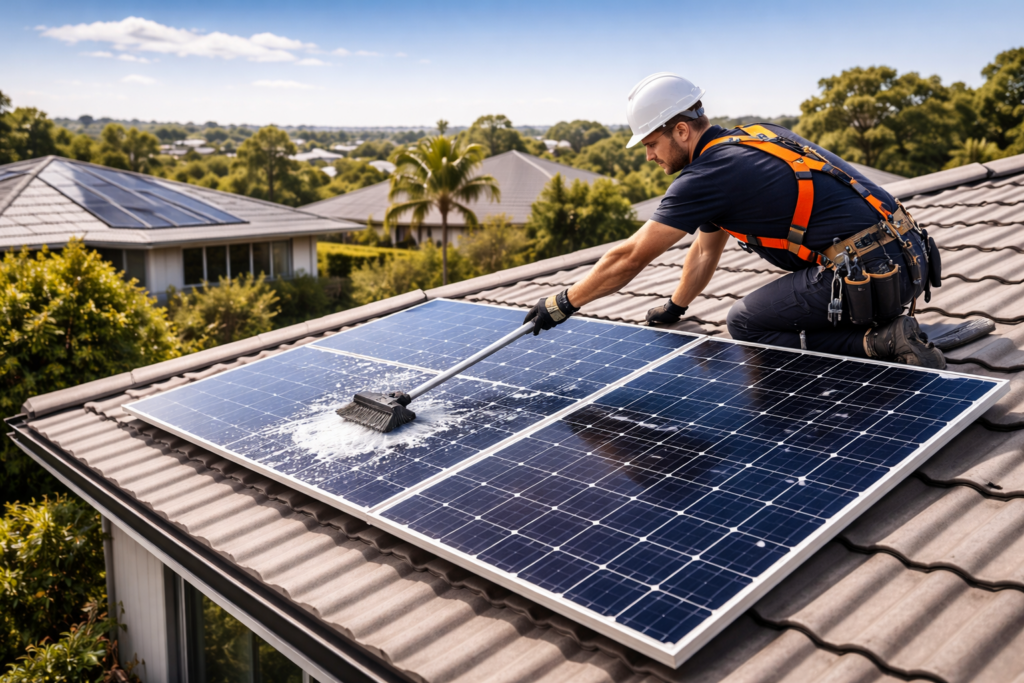
Solar panels are often marketed as “set and forget” — and compared to most home appliances, they genuinely are low maintenance. But low maintenance does not mean no maintenance. In Australia’s uniquely demanding climate, neglecting basic solar panel maintenance can silently cost you thousands of dollars in lost energy generation over the life of your system — without a single fault code on your inverter to warn you something is wrong.
Whether you installed your system last month or five years ago, this expert solar panel maintenance guide covers everything Australian homeowners and businesses need to know to keep their system performing at its best — from DIY cleaning techniques to professional servicing schedules, seasonal care considerations, and the warning signs that should never be ignored.
Why Solar Panel Maintenance Matters More in Australia
Australia is one of the most demanding environments in the world for solar panel maintenance. While the abundant sunshine is the very reason solar performs so well here, it also means Australian panels are exposed to conditions that accelerate soiling, degradation, and component wear more rapidly than in cooler, wetter climates.
The most common environmental factors that make solar panel maintenance critical in Australia include:
Dust and Airborne Particles — Inland and semi-rural properties are exposed to significant dust accumulation, particularly during dry seasons and dust storm events. A film of dust across your panels can reduce output by 5 to 25% depending on severity — a loss that is entirely preventable with regular cleaning.
Bird Droppings — Bird activity on and around rooftops is a significant solar panel maintenance issue across Australia. Unlike dust, bird droppings create concentrated shading on individual cells, which can cause hotspot damage over time — a serious issue that reduces panel lifespan and may void manufacturer warranties if left unaddressed.
Bushfire Ash and Debris — In bushfire-prone regions, ash and leaf debris can accumulate rapidly on panel surfaces and in panel gaps, creating both performance and fire safety concerns.
Coastal Salt Air — Properties within several kilometres of the coastline are exposed to salt-laden air that, over time, deposits a crystalline film on panel surfaces and can accelerate corrosion of frames, junction boxes, and mounting hardware if not addressed during routine solar panel maintenance.
Extreme UV and Heat — Australia’s intense UV environment accelerates the degradation of encapsulant layers and junction box seals faster than in less sun-exposed countries — making professional inspection an important part of long-term solar panel maintenance.
How Often Should You Clean Solar Panels in Australia?
The right cleaning frequency depends on your location, local environment, and roof pitch. As a general guide:
| Location Type | Recommended Cleaning Frequency |
|---|---|
| Urban / Suburban | Every 6 to 12 months |
| Rural / Inland (dusty) | Every 3 to 6 months |
| Coastal (salt air) | Every 3 to 6 months |
| Bushfire-prone region | After every significant fire event + annually |
| High bird activity area | Every 3 to 4 months |
| Low-pitch roof (under 10°) | Every 3 months (rain doesn’t self-clean effectively) |
Panels installed at a pitch of 15 degrees or more in areas with regular rainfall will self-clean to some extent — but only from loose dust, not sticky bird droppings, salt deposits, or ash residue, which require manual attention as part of your solar panel maintenance routine.
DIY Solar Panel Cleaning: Step-by-Step Guide
For most Australian homeowners, basic solar panel maintenance cleaning can be performed safely and effectively as a DIY task with the right approach.
What You Will Need:
- Soft-bristle brush or squeegee with an extension pole
- Garden hose with a gentle spray nozzle
- Mild biodegradable dish soap (optional)
- Soft non-abrasive cloth or chamois
- Safety equipment if roof access is required
Step 1: Choose the Right Time Clean your panels early in the morning or on a cool, overcast day. Never clean hot panels with cold water — the thermal shock can cause microcracks in the glass. Morning cleaning also ensures panels are fully dry and back to optimal output by peak sunlight hours.
Step 2: Turn Off Your Solar System Before beginning any solar panel maintenance, switch off your solar inverter at the isolator switch as directed in your system’s manual. This is a critical safety step.
Step 3: Rinse Panels With Water Use a garden hose to gently rinse the panel surface from top to bottom, removing loose dust and debris. Use a gentle spray — never a high-pressure washer, as this can damage the panel surface, seals, and frame.
Step 4: Gently Scrub if Needed For stubborn bird droppings or salt residue, apply a small amount of mild soapy water with a soft brush or cloth and gently agitate the affected area. Avoid abrasive pads, scourers, or harsh chemical cleaners — these will scratch the anti-reflective coating on your panels and permanently reduce output.
Step 5: Final Rinse and Dry Rinse all soap residue thoroughly with clean water. If possible, use a soft squeegee or chamois to remove water spots, which can leave mineral deposits on the glass surface over time.
Step 6: Restore Power and Check Output Switch your inverter back on and check your monitoring app or inverter display to confirm the system has returned to normal operation.
What NOT to Do When Cleaning Solar Panels
Poor cleaning technique is one of the most common causes of avoidable damage during solar panel maintenance. Always avoid:
| What to Avoid | Why It Causes Damage |
|---|---|
| High-pressure washing | Damages seals, frames, and can cause delamination |
| Abrasive cleaning pads | Scratches anti-reflective coating permanently |
| Harsh chemical cleaners | Degrades encapsulant and frame anodising |
| Cleaning in full sun / heat | Thermal shock causes microcracks in glass |
| Walking on panels | Causes immediate physical damage to cells |
| Metal scrapers or tools | Scratches glass and damages surface coatings |
| Tap water with high mineral content | Leaves hard water deposits — use filtered water if possible |
Professional Solar Panel Servicing: What It Includes
While regular DIY cleaning handles the surface component of solar panel maintenance, professional servicing goes much deeper — inspecting the elements of your system that you cannot assess from the ground or with a garden hose.
A professional solar panel maintenance service typically includes:
Visual Panel Inspection — Physical inspection of all panels for microcracks, delamination, discolouration, hotspots, and physical damage that reduces output or poses a safety risk.
Inverter Health Check — Inspection of inverter error logs, connection integrity, ventilation, and firmware to ensure it is operating within normal parameters.
Wiring and Junction Box Inspection — Checking DC and AC wiring, conduit, junction box seals, and connections for signs of degradation, rodent damage, moisture ingress, or loose terminations — all significant safety and performance risks.
Mounting and Racking Inspection — Checking roof mounting hardware, racking rails, and panel clamps for corrosion, loosening, or structural movement, particularly important in coastal and high-wind regions.
Thermal Imaging (Premium Service) — Infrared thermal imaging identifies hotspots, cell failures, and bypass diode faults invisible to the naked eye — one of the most valuable tools in advanced solar panel maintenance.
Performance Analysis — Comparing actual system output against modelled expected generation to identify any underperformance and diagnose its cause.
How Often Should You Book a Professional Service?
| System Age | Recommended Service Frequency |
|---|---|
| 0 – 2 years | Once — post-installation inspection at 12 months |
| 2 – 5 years | Every 2 years |
| 5 – 10 years | Annually |
| 10+ years | Annually — include thermal imaging every 2 years |
Older systems benefit from more frequent professional solar panel maintenance as component degradation, seal deterioration, and wiring fatigue become increasingly relevant from year 10 onwards.
Warning Signs Your System Needs Immediate Attention
Do not wait for your next scheduled service if you notice any of the following — these are indicators of a problem that should be investigated promptly as part of urgent solar panel maintenance:
Sudden Drop in Energy Output — If your monitoring app shows a significant unexplained drop in daily generation that persists across multiple days, this warrants immediate investigation. A 10–15% or greater sustained drop in output that cannot be explained by weather or seasonal variation is a red flag.
Inverter Fault or Error Codes — Modern inverters display fault codes when something is wrong. Do not ignore these — check your inverter manual for the specific code meaning and contact your installer if the fault persists after resetting.
Discolouration or Yellowing on Panels — Yellow or brown discolouration on panel surfaces or within the panel itself indicates encapsulant degradation or moisture ingress — both of which accelerate further deterioration and may be covered by your product warranty.
Visible Physical Damage — Cracks, chips, delamination bubbles, or broken frames should be reported to your installer immediately. Damaged panels are both a performance and safety concern.
Burning Smell Near Inverter or Switchboard — This is an urgent electrical safety issue that requires immediate power isolation and a call to your installer or a licensed electrician.
Rodent Activity Near Roof Penetrations — Rodents gnawing through DC cabling is an increasingly common issue in Australian homes and can cause arcing, fire risk, and complete system failure.
Solar Panel Maintenance and Your Warranty
Understanding how solar panel maintenance obligations intersect with your warranty is essential for Australian system owners.
Most panel manufacturers require that the system is maintained in a reasonable condition to honour performance warranty claims. Neglect that causes damage — such as bird dropping hotspots that were clearly visible and unaddressed for extended periods — can give a manufacturer grounds to dispute a warranty claim.
Key warranty maintenance points to be aware of:
| Warranty Type | Typical Maintenance Requirement |
|---|---|
| Product Warranty | Proper installation, no physical damage from neglect |
| Performance Warranty | System must be operational and maintained |
| Inverter Warranty | Regular firmware updates, adequate ventilation |
| Workmanship Warranty | Report faults promptly to the installing company |
Keeping a simple maintenance log — recording cleaning dates, any observed issues, and professional service visits — provides documented evidence of proper care if a warranty claim ever becomes necessary.
Seasonal Solar Panel Maintenance Checklist
Australian conditions vary significantly by season. Here is a practical seasonal solar panel maintenance checklist to keep your system in peak condition year-round.
| Season | Maintenance Actions |
|---|---|
| Summer | Check for heat-related inverter shutdowns. Clean panels after dust storms. Ensure inverter ventilation is unobstructed. Monitor output daily. |
| Autumn | Clear leaf debris from panel edges and gutters. Check mounting hardware before winter. Clean panels after any bushfire smoke events. |
| Winter | Check inverter is performing correctly in cold mornings. Clean panels after heavy dew or fog events. Review annual output data. |
| Spring | Full clean after winter. Professional service inspection recommended. Check for bird nesting activity under or near panels. Review monitoring data for any persistent underperformance. |
Does Solar Panel Maintenance Affect Performance?
The short answer is yes — significantly. Studies consistently show that dirty panels in Australian conditions can lose between 5% and 25% of their rated output depending on soiling type and severity. Over a full year, that performance loss has a direct impact on your electricity bill savings and your system’s return on investment.
For a 6.6kW system generating approximately $1,800 per year in electricity savings, a sustained 15% output reduction from poor solar panel maintenance equates to $270 in lost savings annually — money that a single cleaning visit would more than recover. Over a 10-year period, that same neglect compounds to over $2,700 in avoidable losses.
Proper solar panel maintenance is not a cost — it is an investment protection strategy that ensures your system delivers the returns it was designed to provide for its full 25-year lifespan.
If you need professional solar panel maintenance, servicing, or a system health check anywhere in Australia, the expert team at Boost Solar is here to help — from routine cleaning and inspections through to full system diagnostics and repairs.
Frequently Asked Questions
1. How often should solar panels be cleaned in Australia? For most Australian properties, solar panel maintenance cleaning should be carried out every 6 to 12 months. Properties in dusty inland areas, coastal locations, bushfire-prone regions, or areas with high bird activity should clean more frequently — every 3 to 6 months. Panels on low-pitch roofs also require more regular attention as they do not self-clean as effectively in rainfall. Monitoring your system’s output via your inverter app is the most reliable way to detect when soiling is affecting performance and cleaning is overdue.
2. Can I clean my solar panels myself or do I need a professional? Basic surface cleaning is a task most Australian homeowners can perform safely as part of their solar panel maintenance routine — provided they can access their panels safely from the ground using an extension pole, or have safe roof access. Use a soft brush, gentle hose rinse, and mild soapy water if needed. However, if your panels are difficult to access, your roof is steep, or you need anything beyond surface cleaning — such as wiring checks, inverter inspection, or thermal imaging — always engage a qualified solar technician. Safety must always come first.
3. Will rain clean my solar panels naturally? Light rainfall helps remove loose surface dust from panels installed at a reasonable pitch, but it is not sufficient solar panel maintenance on its own. Rain does not remove bird droppings, salt deposits, sticky pollen, or bushfire ash — all of which require manual cleaning. After a rain event, mineral deposits from the water itself can also leave a thin residue on panel surfaces. Regular manual cleaning remains essential even for properties that experience frequent rainfall.
4. Does poor maintenance void my solar panel warranty? Most solar panel manufacturers expect that systems are maintained in a reasonable condition. Neglect that causes or accelerates damage — such as leaving corrosive bird droppings on panels for extended periods, allowing debris to trap moisture against frames, or failing to address visible physical damage — can give manufacturers grounds to dispute warranty claims. Keeping a basic solar panel maintenance log of cleaning dates and any observed issues is a simple and effective way to protect your warranty entitlement for the full duration of your product and performance warranty periods.
5. How much does professional solar panel maintenance cost in Australia? Professional solar panel maintenance service costs in Australia typically range from $150 to $400 for a standard residential inspection and clean, depending on system size, roof accessibility, and the scope of the service. More comprehensive services including thermal imaging, inverter diagnostics, and detailed performance reporting sit at the higher end of this range. While this cost may seem significant for an annual service, it is modest relative to the electricity savings your system generates and the long-term protection it provides for a $5,000 to $14,000+ asset sitting on your roof.
Final Word
Solar panel maintenance is the most overlooked component of solar ownership in Australia — and the one that most directly determines whether your system delivers on its financial promise for 25 years or quietly underperforms while you assume everything is fine.
The good news is that keeping your system in peak condition does not require a significant time or financial commitment. A simple cleaning routine, a professional service every one to two years, and the habit of monitoring your system’s output are all it takes to protect one of the best financial investments your home or business will ever make.
Do not wait until something visibly breaks to pay attention to your solar system. The energy — and money — you save through proper solar panel maintenance compounds every single year.